
Quick Answer: What Does It Cost to Accept Online Payments?
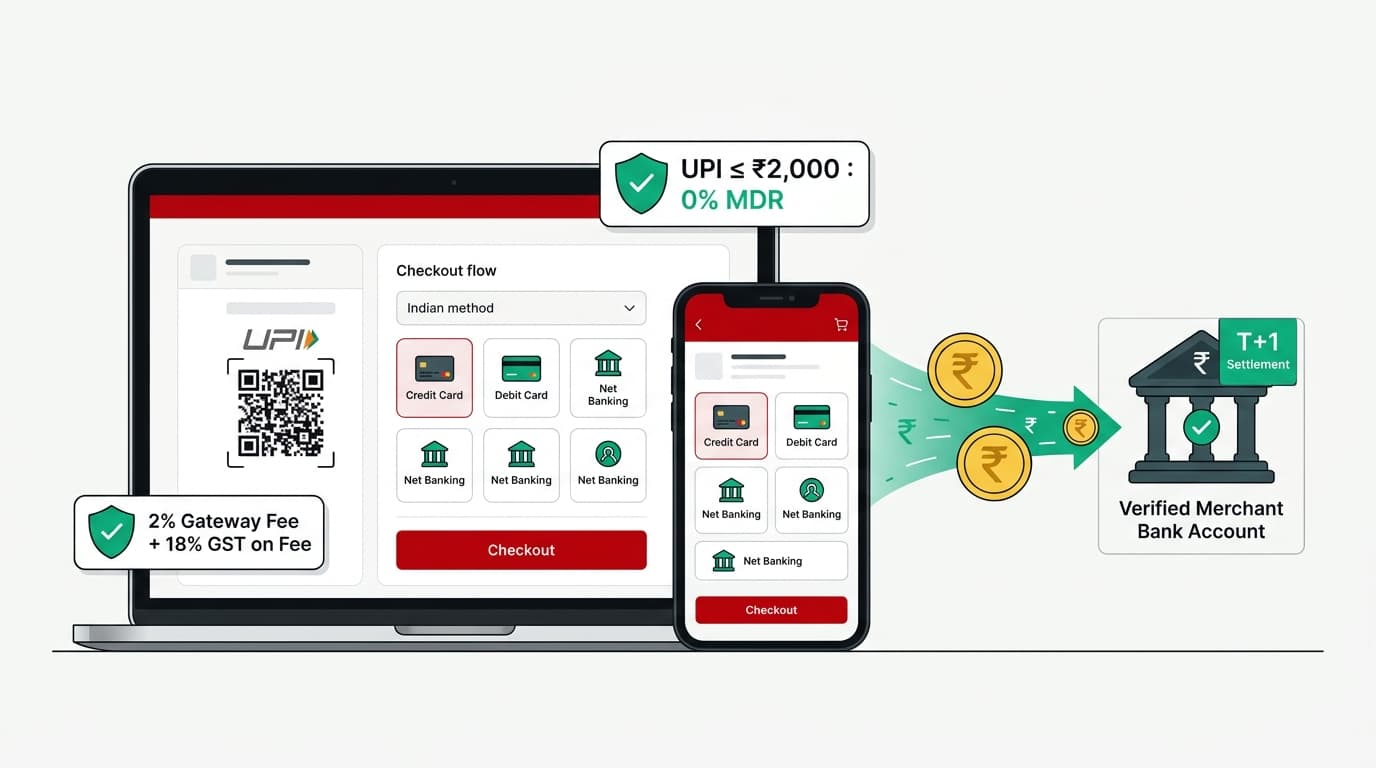
Most Indian payment gateways (Razorpay, Cashfree, PhonePe, PayU) charge roughly 1.95% to 2% per successful domestic payment with ₹0 setup or annual fees, plus 18% GST on the gateway fee only (not on the sale). Under NPCI's October 2026 framework, UPI merchant payments up to ₹2,000 stay 100% free, while payments above ₹2,000 carry a 0.4% MDR (capped at ₹300).
Standard domestic card, netbanking & wallet rate
₹3.60 on a ₹20 fee (100% claimable as GST ITC)
Zero NPCI MDR on P2M UPI up to ₹2,000
Oct 2026 NPCI P2M slab, capped at ₹300 max
Payment Gateway Charges Compared (Razorpay, Cashfree, PhonePe, PayU)
When you move your shop from Instagram DMs or WhatsApp onto your own e-commerce website in Indore or anywhere in India, your payment gateway is the regulated pipe that collects UPI, credit/debit cards, net banking, and wallets, and settles the money into your bank account.
Below is how India's four most popular small-business payment gateways compare on standard published plans. Every rate is verified against the gateway's official pricing page (checked on 12 Nov 2026):
| Gateway | Setup / Annual Fee | Standard Domestic Rate | UPI Rate | International Cards | Settlement Time | Official Source & Checked Date |
|---|---|---|---|---|---|---|
| Razorpay | ₹0 Setup · ₹0 Annual (AMC) | 2.00% + 18% GST (Cards, NetBanking, Wallets); 2.15% on Corporate Cards & Credit-on-UPI | 0% statutory MDR ≤₹2,000; standard platform fee (2%) or introductory 0% promo terms apply as per merchant plan | 3.00% + 18% GST (1% on MoneySaver export bank transfers) | T+1 working days (Instant settlement add-on available) | razorpay.com/pricing Checked: 12 Nov 2026 |
| Cashfree Payments | ₹0 Setup · ₹0 Annual (AMC) | 1.95% + 18% GST (Visa, Mastercard, RuPay, NetBanking, Wallets); 2.20%–2.50% on Pay Later / Credit EMI | 0% on standard P2M UPI (platform promotional / custom volume terms apply) | 2.99% + 18% GST (2.95% for international Amex) | T+1 working days (T+2 for international cards) | cashfree.com/payment-gateway-charges Checked: 12 Nov 2026 |
| PhonePe Payment Gateway | ₹0 Setup · ₹0 Annual (AMC) | ~1.99% + 18% GST on standard domestic cards, net banking & wallets (custom volume slabs available) | 0% on standard P2M UPI (gateway onboarding / promotional plan terms apply) | Custom enterprise quote upon activation | T+1 working days | phonepe.com/business-solutions/payment-gateway Checked: 12 Nov 2026 |
| PayU India | ₹0 Setup · ₹0 Annual (AMC) | 2.00% + 18% GST (Domestic Cards, NetBanking, Wallets, BNPL); 3.00% on Amex, Diners & EMI | 0% statutory MDR on standard P2M UPI (platform plan terms apply) | 3.00% + 18% GST (plus 1.5%–2.5% currency conversion markup) | T+1 to T+2 working days | payu.in/pricing Checked: 12 Nov 2026 |
Why the Cheapest Headline Rate Isn't Always the Best Choice
On paper, a difference between 1.95% and 2.00% looks meaningful. In practice, that 0.05% gap equals just ₹50 per ₹1,00,000 of sales. For a small seller launching an online store, four operational factors matter far more than saving ₹50 per lakh:
1. Onboarding & KYC Approval Speed
Some gateways activate sandbox and initial live collections within 24–48 hours for sole proprietors, while others hold settlements until physical verification or extra bank letters are cleared.
2. Mobile UPI Intent Success Rate
If one extra customer out of 100 abandons checkout because the UPI popup lagged or failed to open Google Pay / PhonePe smoothly, you lose ₹1,000+ in revenue — wiping out any 0.05% fee savings immediately.
3. Settlement Predictability & Reconciliation
Predictable T+1 settlements (money hits your bank account the next working day) and clean dashboard reports (showing order ID, gateway fee, GST deducted, and UTR number) save hours of monthly accounting headaches.
4. Plugin Stability & Webhook Reliability
Whether your store runs on WooCommerce, Shopify, or a custom Next.js stack, webhook reliability ensures an order is never marked “Payment Pending” after money has been debited from the buyer's bank.
GST on Gateway Fees: What You Actually Pay (Worked ₹1,000 Example)
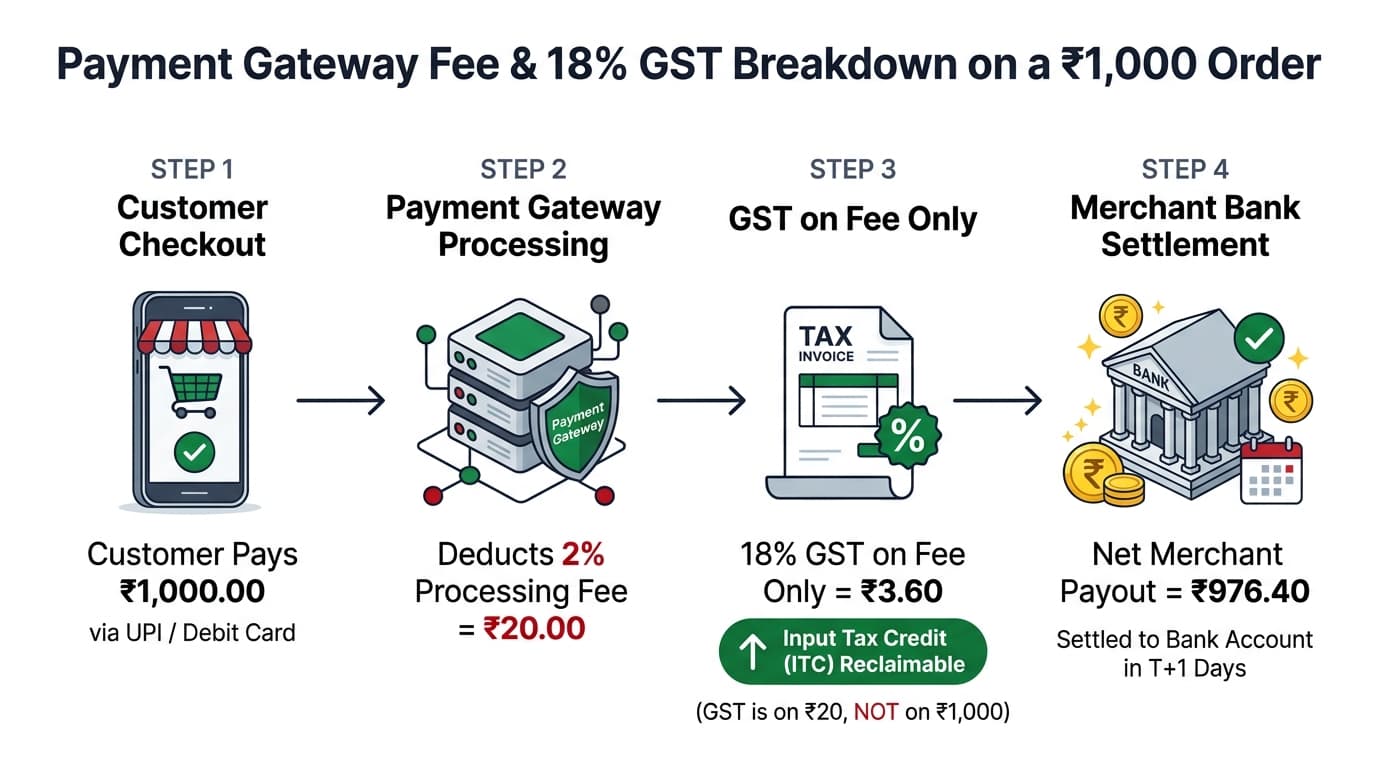
One of the biggest misconceptions among first-time online sellers is how the 18% GST mentioned on payment gateway pricing pages works. The 18% GST is charged strictly on the gateway's processing fee — NEVER on your customer's order value.
Under Indian GST law (see gst.gov.in ↗), payment gateway processing is a B2B financial/technology service supplied by the gateway to you (the merchant), taxed at 18%. Here is the exact math on a ₹1,000 customer order at a standard 2.00% gateway rate:
| Step in Transaction | Calculation | Amount (₹ INR) | What It Means for You |
|---|---|---|---|
| 1. Customer Order Value | Customer pays at checkout | ₹1,000.00 | Full price paid by buyer (no extra fee added to customer) |
| 2. Payment Gateway Fee (2%) | ₹1,000 × 2.00% | − ₹20.00 | Service fee retained by Razorpay / PayU / gateway |
| 3. 18% GST on Gateway Fee | 18% of ₹20.00 (0.36% of order) | − ₹3.60 | Tax on the ₹20 service fee — not 18% of ₹1,000 |
| 4. Total Deduction (2.36%) | ₹20.00 + ₹3.60 | − ₹23.60 | Total deducted before settlement |
| 5. Net Bank Settlement | ₹1,000.00 − ₹23.60 | ₹976.40 | Credited to your bank account on T+1 working day |
Interactive Gateway Fee, 18% GST & UPI MDR Calculator
Can You Claim Back the ₹3.60 GST? (Input Tax Credit)
Yes — if your business is registered under the Regular GST scheme. At the end of every month, your payment gateway issues a B2B GST tax invoice carrying your GSTIN. That invoice reflects in your GSTR-2B statement on the GST portal, allowing you to claim the ₹3.60 as Input Tax Credit (ITC) to offset your output GST liability. As a result, for a regular GST-registered seller, the net real cost of the gateway is strictly ₹20.00 (2.00%). Unregistered sellers and Composition Scheme taxpayers cannot claim ITC, so their effective cost remains 2.36%.
The UPI Change from 15 October 2026 (MDR), Explained Simply
In late September and October 2026, viral forwards across WhatsApp and social media caused panic among small shopkeepers by claiming “18% GST is coming on all UPI payments above ₹2,000 from 15 October 2026.” Let's separate the panic from the actual regulatory rules issued by the National Payments Corporation of India (NPCI) ↗ (checked on 12 Nov 2026).
1. No GST on the Amount the Customer Pays by UPI
First and most importantly: customers do not pay any GST or surcharge for using UPI, whether they pay ₹50 or ₹50,000. UPI is a payment mode, not a separate taxable good. Any GST on an order depends strictly on the product you sell (and whether you are GST-registered), plus 18% GST on whatever small service fee (MDR) the bank or payment processor charges the merchant.
2. Who Pays What Under the October 2026 NPCI UPI MDR Framework
As per the NPCI circular framework (dated 15 September 2026 for the 15 October 2026 structure, with implementation subsequently deferred by NPCI past the Diwali festive window pending final notification), here is how Person-to-Merchant (P2M) UPI Merchant Discount Rate (MDR) is structured:
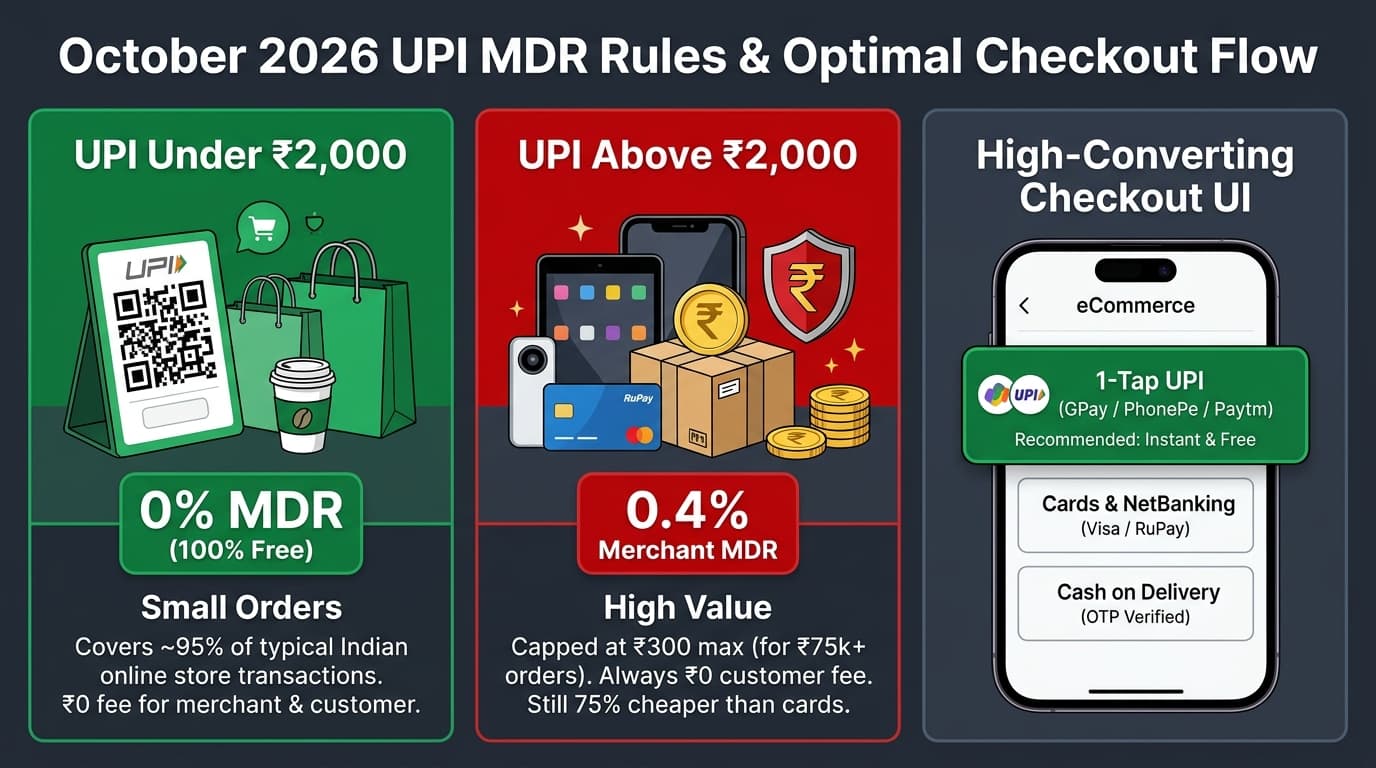
UPI Payments up to ₹2,000 → 0% MDR (Free)
All P2M UPI transactions of ₹2,000 or less remain 100% free (zero MDR). According to government and NPCI data, this slab covers roughly 95% to 96% of everyday retail and small-ticket online orders. Small merchants receiving up to ₹1,00,000/month via QR are also protected.
UPI Payments above ₹2,000 → 0.4% Merchant MDR
For eligible P2M UPI transactions exceeding ₹2,000, a standard 0.4% MDR applies to the merchant, plus 18% GST on that 0.4% fee. For example, on a ₹5,000 UPI order, the 0.4% MDR is ₹20.00 + ₹3.60 GST (claimable as ITC if GST-registered) = ₹23.60 total merchant cost.
Capped at ₹300 for High-Value Orders (₹75,000+)
If you sell high-ticket electronics, jewellery, or furniture online, the 0.4% UPI MDR is capped at a maximum of ₹300 per transaction (reached at ₹75,000). Even on a ₹1,00,000 UPI payment, the MDR does not exceed ₹300 (+ ₹54 GST).
P2P Transfers (Friends & Family) → 100% Unaffected
Person-to-Person (P2P) UPI bank transfers between individuals remain completely free at all amounts. However, using a personal savings QR for commercial store orders violates bank terms and triggers account freezes once volume grows.
3. Can You Add a “UPI Charge” to the Customer's Bill?
No. Under Section 10A of the Payment and Settlement Systems Act and explicit NPCI guidelines ↗, merchants and payment apps are strictly prohibited from passing MDR charges onto consumers or adding a “UPI convenience surcharge” at checkout. Your product price must remain the same whether the customer pays via UPI or debit card (though you are allowed to offer a prepaid discount compared to Cash on Delivery handling fees).
4. How the NPCI MDR Relates to Your Payment Gateway's Own UPI Fee
When you integrate an online payment gateway (Razorpay, Cashfree, PhonePe PG, or PayU) on your website, understand the two layers:
- Cashfree, PhonePe PG & PayU: Publish 0% on standard peer-to-merchant (P2M) UPI transactions under current statutory zero-MDR norms (checked 12 Nov 2026), while charging ~1.95%–2.00% on cards, net banking, and wallets (and ~2.15% on Credit Card on UPI / RuPay Credit on UPI).
- Razorpay: Lists a flat 2.00% platform/infrastructure fee across domestic methods on its standard self-serve plan (often paired with a 0% introductory promo for eligible new accounts), unless you negotiate a custom UPI rate at higher monthly volumes.
- When NPCI's 0.4% MDR above ₹2,000 takes effect: For gateways offering 0% on standard UPI, orders ≤₹2,000 continue at 0%, while P2M UPI orders >₹2,000 reflect the applicable NPCI 0.4% MDR framework (unless absorbed or bundled in your merchant plan).
Do You Need GST Registration to Sell Online in India?
Whether you need a 15-digit GSTIN before launching your online store depends on where you sell and who collects the payment. Under the Central Goods and Services Tax (CGST) Act (refer to gst.gov.in ↗), three rules govern online sellers:
1. The Turnover Threshold Rule (Intra-State Only)
If you sell exclusively within your own state (for example, an Indore bakery, boutique, or organic store delivering only within Madhya Pradesh) on your own website, GST registration is generally not required until your aggregate annual turnover exceeds ₹40 lakh for goods (or ₹20 lakh for services; lower thresholds apply in special category states).
2. The Inter-State Supply Rule (Shipping Pan-India)
Under Section 24(i) of the CGST Act, making any inter-state taxable supply of goods (e.g., shipping a kurti or snack box from Indore, MP to a buyer in Mumbai, Maharashtra or Delhi) requires compulsory GST registration from ₹1 of sales, even if your turnover is under ₹40 lakh. (Note: Inter-state supply of services and notified handicraft goods have specific threshold exemptions up to ₹20 lakh subject to conditions).
3. Marketplace vs. Your Own Website Rule
Selling on third-party marketplaces (Amazon, Flipkart, Myntra) that collect Tax Collected at Source (TCS) under Section 52 triggers mandatory GST considerations (with limited intra-state composition/enrollment relaxations). When you sell on your own website via Razorpay or Cashfree, your website is your own storefront — not a third-party marketplace operator collecting TCS.
4. Onboarding Gateways Without GSTIN
Razorpay, Cashfree, and PhonePe allow sole proprietors and individual sellers below the GST threshold to onboard using their Personal PAN + Udyam (MSME) Certificate / Shop Act license + Bank Account. Once you obtain a GSTIN later, you can add it in the gateway settings to start claiming 18% ITC on gateway fees.
Not Tax Advice — Talk to Your CA
Tax thresholds, HSN slab rates (0%, 5%, 12%, 18%), and composition scheme rules depend on your specific product category and state notifications. This guide is for practical technical and store-planning reference only — always confirm your exact GST registration and invoicing requirements with a qualified Chartered Accountant (CA) before going live.
UPI, Cards, Wallets and COD: What to Switch On at Checkout
How you order and configure payment options on your checkout screen directly impacts both your conversion rate and your payment gateway fee bill. Here is the proven checkout setup we configure for Indian online stores:
- Put UPI Intent #1 on Mobile (70%+ of Orders): On smartphones, the checkout should immediately display one-tap buttons for Google Pay, PhonePe, Paytm, and BHIM (UPI Intent) rather than forcing buyers to type a `name@okaxis` UPI ID manually. On desktop, display a dynamic Scan & Pay UPI QR code right at the top.
- Enable Debit/Credit Cards & NetBanking for ₹2,000+ Carts: Buyers purchasing higher-ticket items (apparel sets, appliances, courses, jewellery) frequently prefer Credit Cards or Card EMIs. Keep Visa, Mastercard, and RuPay enabled.
- Switch Off High-Fee BNPL / International Unless Needed: Some Buy-Now-Pay-Later (BNPL) and corporate card modes charge 2.50% to 3.00%+. Enable them only if your average order value (AOV) and gross margin justify the fee.
- Use “Smart COD” + Prepaid Nudges: In India, first-time buyers discovering your store from Instagram Reels or WhatsApp ↗ often look for Cash on Delivery (COD). However, unverified COD leads to higher Return-to-Origin (RTO) courier losses. Protect your store with three rules:
- Prepaid Nudge: Offer “Extra ₹40 OFF + Priority Dispatch on UPI Prepaid Orders” or add a transparent ₹50 COD handling fee.
- Order Value Cap & PIN Check: Restrict COD to serviceable courier PIN codes and orders between ₹300 and ₹3,000.
- Automated WhatsApp / OTP Confirmation: Trigger an automated WhatsApp message asking the buyer to tap “Confirm COD Order” before you print the shipping label.
What Payment Gateways Check Before Approving Your Store
Many DIY sellers try applying for Razorpay, Cashfree, or PhonePe with an unfinished site or an Instagram profile link, only to have their merchant account rejected or settlements frozen. Under RBI Payment Aggregator (PA) compliance norms, every gateway's risk team manually or algorithmically inspects your website before enabling bank settlements:
1. Live Products with Prices in ₹ INR
Your website must be publicly accessible (no “Coming Soon” screen or dummyLorem Ipsum products) with real product photos, descriptions, and prices clearly denominated in Indian Rupees (₹).
2. The 4 Mandatory Legal Policy Pages
Gateways check your website footer for four specific links: Privacy Policy, Terms & Conditions, Refund & Cancellation Policy (stating exact refund timeline in working days), and Shipping & Delivery Policy (stating dispatch & delivery timelines).
3. Legal Name & Address Match on Contact Page
Your Contact Us and About pages must display the exact registered legal/trade name, physical operational address, working phone number, and email that match your PAN, GSTIN/Udyam certificate, and bank account.
4. SSL Security (HTTPS) & Clean Domain
Checkout and callback URLs must run over encrypted https:// on your own custom domain. This is why a properly engineered store on MS HOST ↗ with pre-configured compliance pages gets approved smoothly on the first submission.
Launch Checklist: Payments, KYC & GST
Use this scannable checklist before submitting your store for payment gateway activation:
1. Business & Bank Readiness
- Active current account in your business/trade name (or savings account for individual/sole proprietor onboarding where supported)
- PAN card (Personal PAN for sole proprietors; Business PAN + incorporation certificate/partnership deed for registered entities)
- Udyam Registration (MSME) certificate or Shop & Establishment license (speeds up sole-proprietor KYC verification)
- GSTIN certificate (mandatory if selling inter-state goods or exceeding the ₹40L/₹20L threshold; optional for intra-state exempt micro-sellers)
2. Website & KYC Compliance Pages
- Live, password-free product catalog with clear descriptions and prices listed in Indian Rupees (₹ INR)
- Dedicated Contact Us page showing legal business name, registered physical address (e.g., Indore, MP), phone number, and support email
- Four mandatory footer policy pages: Privacy Policy, Terms & Conditions, Refund & Cancellation Policy (with timeline in days), and Shipping & Delivery Policy
- Active SSL certificate (HTTPS padlock) on your custom .in or .com domain
3. Checkout & Tax Configuration
- UPI Intent (GPay, PhonePe, Paytm) placed as the #1 default payment option on mobile checkout
- Cards, NetBanking, and Wallets enabled for higher-value orders (>₹2,000)
- Cash on Delivery (COD) restricted by serviceable PIN codes, order value caps, and WhatsApp/OTP confirmation
- Automated order receipts / GST tax invoices configured (showing HSN code and CGST/SGST or IGST split if GST-registered)
Store with UPI, cards and GST invoices set up — from ₹10,000
We build your mobile-first online store, write all 4 gateway KYC policy pages, integrate Razorpay/Cashfree/PhonePe, and test live UPI & COD flows before handoff.
What an Online Store with Payments Set Up Costs at Meera Solution
At Meera Solution in Indore, we build fast, conversion-focused online stores for Indian sellers — whether you need WooCommerce, Shopify, or a high-speed custom Next.js storefront. Every package is fixed-price with transparent deliverables:
Starter Online Store
- Mobile-first e-commerce store with cart & 1-page checkout
- Razorpay or Cashfree payment gateway setup + live transaction testing
- Instant UPI Intent (GPay, PhonePe, Paytm), Cards & NetBanking
- Cash on Delivery (COD) with PIN-code check & fee rules
- All 4 gateway-compliant KYC policy pages (Privacy, Terms, Refund, Shipping)
- WhatsApp 1-click chat button & automated order notifications
- Basic stock tracking, coupon codes & 30-day technical support
Growth D2C Store
- Unlimited products, advanced variant filters & smart search
- Automated GST tax invoices with HSN codes & CGST/SGST/IGST split
- Multi-gateway routing (Razorpay + Cashfree / PhonePe PG) & prepaid nudges
- Automated courier integration (Shiprocket / Delhivery) with AWB tracking
- Abandoned cart recovery via WhatsApp & email webhooks
- Meta Pixel & Google Analytics 4 purchase conversion tracking
- 60 days post-launch technical support & staff admin training
Custom / Scale E-Commerce
- Custom Next.js / Headless Shopify or bespoke full-stack architecture
- Automated Tally / Zoho Books / ERP accounting & GSTR-1 export sync
- Multi-vendor split settlements (Razorpay Route / Cashfree Easy Split)
- International multi-currency checkout & export FIRA/eFIRC workflows
- High-concurrency cloud infrastructure on MS HOST / AWS
- Dedicated engineering SLA & priority WhatsApp support
Explore full package deliverables on our Online Store & E-Commerce Packages page (/for-ecommerce) ↗, or compare overall website and store build budgets in our detailed guide on Website Development Cost in India (2026) ↗. Need fast, secure Indian cloud hosting for your store? Check MS HOST Cloud Hosting ↗ or reach our Indore team via our Contact page ↗.
Frequently Asked Questions
Direct answers to the most common questions Indian online sellers ask about payment gateway charges, GST, and UPI MDR:
Most major Indian payment gateways charge around 1.95% to 2.00% per successful domestic transaction with ₹0 setup fee and ₹0 annual maintenance, plus 18% GST on the gateway fee.
As checked on 12 Nov 2026 on official pricing pages, standard domestic rates are 2.00% at Razorpay and PayU, 1.95% at Cashfree, and ~1.99% at PhonePe Payment Gateway. Because 18% GST applies only to the gateway's service fee, a 2% fee equals an effective deduction of 2.36% (₹23.60 on a ₹1,000 order).
Among standard published plans, Cashfree (1.95%) and PhonePe Payment Gateway (~1.99%) list slightly lower base rates than Razorpay and PayU (2.00%), while several gateways run 0% introductory promos for new merchants.
However, a 0.05% rate difference is only ₹50 per ₹1,00,000 in sales. For a small online store, approval speed, UPI checkout success rate, T+1 settlement reliability, and clean WooCommerce/Shopify/Next.js integration matter far more than a 0.05% headline difference.
Yes, 18% GST is charged on the payment gateway's processing fee — never on the total product order value.
Payment gateway processing is classified as a financial service under GST. On a ₹1,000 customer order with a 2% gateway fee (₹20), the 18% GST is calculated strictly on the ₹20 fee, which equals ₹3.60. If your business is GST-registered (regular scheme), you can claim that ₹3.60 back as Input Tax Credit (ITC) via GSTR-2B.
No. There is zero GST levied on the money a customer transfers via UPI, and everyday UPI payments up to ₹2,000 carry zero MDR and zero GST.
Viral WhatsApp forwards claiming '18% GST on UPI payments above ₹2,000' are misleading. Under the NPCI MDR framework announced for October 2026, customers pay ₹0 extra on UPI. Only on merchant (P2M) transactions above ₹2,000 where a 0.4% MDR applies does the bank/processor charge 18% GST on that small 0.4% MDR service fee — never on the transaction amount itself.
MDR (Merchant Discount Rate) is the small processing fee a merchant's bank or payment provider charges the seller to process a digital payment; the merchant pays it, never the customer.
Under NPCI's revised framework (circular dated 15 Sep 2026 for 15 Oct 2026 rollout, subsequently deferred past the festive window), P2M UPI payments up to ₹2,000 remain at 0% MDR, and small merchants with ≤₹1 lakh monthly QR volume are exempt. Eligible P2M UPI transactions above ₹2,000 attract a 0.4% MDR paid by the merchant (capped at ₹300 for ₹75,000+ transactions, with a ₹5 flat fee for fuel, rail, telecom, utilities, and insurance). Merchants are legally barred from adding a UPI surcharge to the customer's bill.
If you sell goods across state lines (inter-state pan-India shipping) or sell through e-commerce marketplaces that collect TCS, GST registration is generally mandatory from ₹1 of sales.
Under Section 24 of the CGST Act, inter-state taxable supply of goods requires compulsory GST registration regardless of turnover. If you only sell within your own state (e.g., intra-state delivery within Madhya Pradesh) on your own website, standard threshold exemptions apply (typically ₹40 lakh for goods / ₹20 lakh for services). Because tax rules depend on your exact product HSN and state, always confirm with your Chartered Accountant (CA).
Yes, in specific scenarios — such as selling GST-exempt goods (e.g., fresh unbranded produce, books), supplying services within the ₹20 lakh threshold, or selling goods strictly within your own state below the threshold.
Many home bakers and hyperlocal boutiques in Indore start by selling strictly within their city on their own website using individual/sole-proprietor PAN onboarding before applying for GSTIN to ship pan-India. Always ask your CA before enabling inter-state shipping.
Instant activation takes 10–30 minutes with PAN and bank details, while full KYC verification and settlement activation typically take 2 to 4 working days.
Gateways require your PAN card, cancelled cheque or bank statement, business registration proof (GSTIN, Udyam MSME, or Shop Act license), and a live website featuring prices in ₹ INR alongside four mandatory pages: Privacy Policy, Terms & Conditions, Refund & Cancellation Policy, and Shipping & Delivery Policy.
Yes, for Indian D2C stores COD still drives 40%–65% of first-time orders, but you should protect margins with OTP verification, PIN-code checks, and a small prepaid discount nudge.
Turning off COD completely can hurt conversions from first-time Instagram visitors who don't know your brand yet. The smart approach is enabling COD with automated WhatsApp/OTP confirmation, capping maximum COD order value (e.g., ≤₹3,000), charging a transparent ₹40–₹60 COD handling fee, or offering 'Flat ₹50 off on UPI Prepaid orders' to shift buyers toward instant UPI.
Explore Related Services from Meera Solution
Store with UPI, Cards and GST Invoices Set Up — From ₹10,000
Skip the gateway rejection headaches and manual DM orders. Our Indore engineering team builds your mobile-first online store with Razorpay/Cashfree, instant UPI checkout, COD rules, and KYC policy pages ready in 5–7 days.